The Supreme Court on Wednesday, October 14, 2026, dismissed an application by former Ghana Infrastructure Investment Fund (GIIF) Chief Executive Officer Solomon Asamoah seeking to quash a High Court ruling and stop the trial judge from continuing to hear the $2 million Sky Train case against him.
A five-member panel presided over by Justice Gabriel Scott Pwamang refused the applications for certiorari and prohibition. The court held that the concerns raised did not provide sufficient grounds to warrant the exercise of its discretionary supervisory jurisdiction.
The other members of the panel were Justices Adibu Asiedu, Hafisata Amaleboba, Sophia Bernasko-Essah and Anthony Forson Jnr.
The decision means the trial continues at the High Court before Justice Audrey Kocuvie-Tay, and Mr Asamoah must open his defence.
Supreme Court refuses certiorari and prohibition in Sky Train case
Mr Asamoah invoked the Supreme Court’s supervisory jurisdiction after the High Court, on July 2, 2026, dismissed his submission of no case to answer. His application was filed on August 21, 2026.
He asked the apex court to quash that ruling and to prohibit Justice Kocuvie-Tay from further hearing the case.
The panel found no basis to intervene, clearing the way for the defence stage of the trial to proceed.
Why Solomon Asamoah went to the Supreme Court
Counsel for Mr Asamoah, Prince Asafo-Agyei, argued that the trial judge exceeded her jurisdiction by deciding, at the no-case stage, whether the prosecution’s evidence was sufficient for a conviction.
He objected to the judge’s statement that Mr Asamoah was “the direct cause of the loss,” arguing it could prejudice the defence.
Counsel also challenged the reversion of Mr Asamoah’s bail to monthly reporting conditions on July 30, 2026, saying there was no application for variation and no notice was given. He further alleged “off-record proceedings” on July 2 and argued that the cumulative effect created a reasonable apprehension of bias.
Attorney-General’s response to the bias claims
Deputy Attorney-General Dr Justice Srem-Sai opposed the application. He said the bail complaint was unfounded because the variation Mr Asamoah obtained on February 9, 2026 was tied to the trial’s continuation, and the judge reverted to the original conditions when that period ended.
He argued that the jurisdiction complaint rested on a misunderstanding of the elements of the offence and that the bias allegations established no element of bias.
“We do not see any injustice in this case,” Dr Srem-Sai told the court.
What the $2m Sky Train case is about
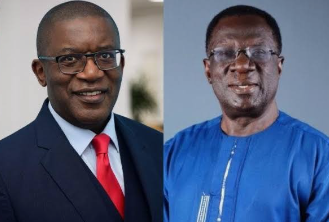
Mr Asamoah is standing trial with Professor Christopher Ameyaw-Akumfi, a former Board Chairman of GIIF. Both have pleaded not guilty.
The prosecution alleges that $2 million linked to the proposed Accra Sky Train project was transferred from GIIF’s account to Africa Investor Holdings Limited, a South African company, without board approval. The state says no work was done to justify the payment, and the Sky Train was never built.
GhanaTrends earlier reported on the Attorney-General’s case against Solomon Asamoah over the Sky Train payment.
Sky Train trial timeline
- February 9, 2026: Mr Asamoah obtains a variation of his bail conditions.
- July 2, 2026: High Court dismisses the submission of no case and orders the accused to open their defence.
- July 30, 2026: Trial judge reverts Mr Asamoah to monthly reporting bail conditions.
- August 21, 2026: Certiorari and prohibition application filed at the Supreme Court.
- August 31, 2026: A single Supreme Court justice, Justice Senyo Dzamefe, dismisses Mr Asamoah’s injunction bid to halt the trial.
- October 14, 2026: Five-member Supreme Court panel dismisses the certiorari and prohibition application.
What the ruling means for Solomon Asamoah
With both the injunction and the main supervisory application rejected, Mr Asamoah has no pending Supreme Court challenge to stop the trial. He must now present his defence before the same judge he sought to remove.
Concerns about the judge’s findings at the no-case stage can still be raised on appeal after the trial, which is the route the single justice pointed to in August.
What happens next in the Sky Train trial
The case returns to the High Court for the defence stage. A date for the next hearing had not been announced at the time of publication.
Proceedings and cause lists can be followed through the Judicial Service of Ghana.
Key details at a glance
- Court: Supreme Court of Ghana, five-member panel presided over by Justice Gabriel Scott Pwamang
- Date: Wednesday, October 14, 2026
- Applicant: Solomon Asamoah, former CEO of GIIF
- Decision: Applications for certiorari and prohibition dismissed
- Amount in dispute: $2 million allegedly paid without board approval
- Co-accused: Prof. Christopher Ameyaw-Akumfi, former GIIF Board Chairman
- Trial judge: Justice Audrey Kocuvie-Tay, High Court
FAQs
What did the Supreme Court decide in the Sky Train case?
On October 14, 2026, the Supreme Court dismissed Solomon Asamoah’s application to quash the High Court’s no-case ruling and to stop Justice Audrey Kocuvie-Tay from hearing the trial.
What is the Sky Train $2 million case about?
The state alleges that $2 million linked to the proposed Accra Sky Train project was paid from GIIF to Africa Investor Holdings Limited without board approval. Solomon Asamoah and Prof. Christopher Ameyaw-Akumfi have pleaded not guilty.
Will Solomon Asamoah open his defence?
Yes. The ruling means the trial continues at the High Court, and Mr Asamoah is required to open his defence.
The Supreme Court’s decision removes the last pending obstacle Solomon Asamoah had placed before the $2 million Sky Train trial. The case now returns to Justice Audrey Kocuvie-Tay’s court, where the former GIIF CEO and his co-accused will present their defence against the state’s allegations.