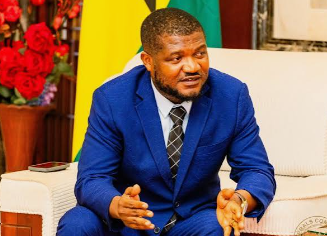
The Chief Executive of the Minerals Commission, Isaac Andrews Tandoh, has asked China to treat illegal mining by its nationals in Ghana as a bilateral enforcement priority, insisting that foreigners caught in galamsey must face the full penalty of 20 to 25 years in prison before deportation.
He made the call on Tuesday, November 10, 2026, at the China-Ghana Mining Cooperation Conference held at the Kempinski Hotel in Accra.
The event was attended by Chief of Staff Dr Julius Debrah, China’s Ambassador to Ghana Cong Song, Ghana Chamber of Mines President Ing. Frederick Attakumah, Chamber CEO Dr Ken Ashigbey, ministers of state, industry players and traditional leaders.
Mr Tandoh said a “lawless minority” was undermining a Ghana-China friendship that spans six decades, and that the relationship was being tested in Ghana’s rivers, forest reserves and farmlands.
Minerals Commission CEO: galamsey an “existential threat”
“Illegal small-scale mining has become an existential threat to our environment, our water bodies, and our national security,” Mr Tandoh said.
He stressed that Ghana’s mining rules apply equally to all operators and that no foreign national or investor will be shielded from sanctions for breaking the law.
The Commission, he said, will enforce the law “without fear or favour” while continuing to work with investors who share its vision.
What Ghana’s mining law says about foreigners in small-scale mining
Under the Minerals and Mining Act, 2006 (Act 703), as amended, small-scale mining licences are reserved for Ghanaian citizens. Mr Tandoh explained that any foreigner engaged in small-scale mining commits an offence.
- Penalty for foreigners in small-scale mining: 20 to 25 years’ imprisonment, followed by deportation
- “Fronting”: the law also targets foreign entities that use Ghanaians to obtain mineral rights on their behalf
- Recent arrests: several Chinese nationals have been arrested in raids on the Birim and Tano rivers
Three requests to China on illegal mining
Mr Tandoh put three specific requests to the Chinese government:
- Dual enforcement: promptly implement the framework agreed at the 2026 China Mining Conference, under which offenders face sanctions in Ghana and also through Chinese authorities’ own mechanisms. Deportation, he said, should not be “a soft landing.”
- Break the networks: work with Ghana to dismantle the financing and logistics networks behind illegal mining, since equipment and capital sometimes come from outside the country.
- Industry association: use the Association of China-Ghana Mining to promote compliance, including discouraging and reporting illegal conduct by members and Chinese nationals in Ghana.
Speaking on the proposed framework, he said “Chinese law will also take care of them,” meaning those convicted in Ghana could face further action when they return home.
Chinese ambassador calls for balanced mining cooperation
Ambassador Cong Song called for a balanced approach to mining cooperation and warned against using Africa’s natural resources for geopolitical rivalry. “Africa’s resources should not be used for political rivalry,” he said, stressing mutual respect for African countries’ development priorities.
The conference also unveiled the China-Ghana Mining Talent Development Centre (CMTDC), a training hub for Ghanaian mining workers focused on technical skills, knowledge exchange and technology transfer.
Chinese large-scale miners praised
While condemning illegal operators, Mr Tandoh praised large-scale Chinese investment. He noted that Zijin, which took over the Akyem mine a year ago, raised production by 20% without expanding its workforce, and that Shandong Gold’s Ghana operation is the best-performing mine in the group globally. Chifeng was also named among major Chinese players.
Ghana is Africa’s largest gold producer and the sixth-largest in the world.
What it means for foreign and small-scale miners
For foreigners, the message is clear: small-scale mining is off-limits, and getting caught could mean decades in jail plus possible action back home.
For law-abiding Ghanaian small-scale miners, the government has designated blocked-out areas. A new medium-scale tier is also being provided for by law, allowing Chinese and other foreign nationals without large-scale capacity to co-own up to 40% of mining companies with Ghanaian partners.
The push follows government’s wider anti-galamsey drive, including soldiers remaining in all nine cleared “red zone” forest reserves.
What happens next
Attention now turns to how quickly the dual-enforcement framework with China is put into practice, and whether arrests of foreign nationals lead to prosecutions under Act 703. More details on mining regulation are available from the Minerals Commission.
Quick Summary
- Who: Isaac Andrews Tandoh, CEO, Minerals Commission
- Where: China-Ghana Mining Cooperation Conference, Kempinski Hotel, Accra
- When: Tuesday, November 10, 2026
- Penalty for foreigners in small-scale mining: 20–25 years in jail, then deportation
- Key ask: dual enforcement – sanctions in Ghana and in China
- Arrests: several Chinese nationals picked up on the Birim and Tano rivers
- New medium-scale tier: foreigners may co-own up to 40% with Ghanaian partners
FAQs: Minerals Commission CEO Wants Chinese Galamsey Offenders Punished in Ghana and China, Says Deportation Must Not Be a ‘Soft Landing’
Can foreigners do small-scale mining in Ghana?
No. Under the Minerals and Mining Act, 2006 (Act 703), as amended, small-scale mining licences are reserved for Ghanaian citizens only.
What is the punishment for foreigners involved in galamsey in Ghana?
According to the Minerals Commission CEO, foreigners caught in small-scale mining face 20 to 25 years in prison, followed by deportation.
What is the Ghana-China dual enforcement framework on illegal mining?
It is an arrangement under which Chinese nationals convicted of illegal mining in Ghana would also face sanctions through Chinese authorities’ own mechanisms after deportation.
The Minerals Commission’s message to Beijing is that illegal mining “has no place” in the Ghana-China partnership. With a dual-enforcement plan on the table, tough jail terms in Ghana’s law and a fresh push against financing networks, foreign galamsey operators could soon find there is no safe exit.