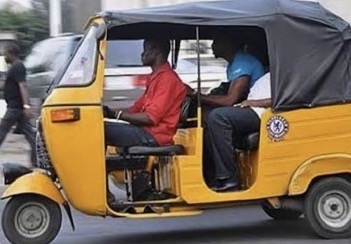
The National Road Safety Authority (NRSA) says the rule requiring pragyia riders and their passengers to wear helmets was included in Ghana’s road traffic regulations by mistake, but until Parliament amends the law, passengers caught without helmets can still be fined or jailed for up to eight months.
NRSA Director-General Abraham Amaliba made the admission on Joy FM’s Midday News on Tuesday, November 24, 2026, hours after the Motor Traffic and Transport Department (MTTD) of the Ghana Police Service warned that passengers found without helmets would be arrested in upcoming operations.
He said the helmet clause was meant for aboboya tricycles, which mainly carry goods, and not for commercial passenger tricycles popularly called pragyia. He could not give a date for the correction.
The issue has made the front pages of Wednesday’s newspapers, with The New Publisher leading with the headline that pragyia passengers without helmets will be arrested and jailed for eight months.
NRSA says pragyia helmet rule was a mistake
“The provision that talks about tricycle drivers wearing a helmet is a mistake,” Mr Amaliba said.
“Those who are supposed to wear helmets are the aboboya, and not tricycles,” he added, explaining that the confusion arose because both vehicle types are classified as tricycles in the regulations.
He argued that pragyia should be treated like minicars or taxis, meaning drivers should not have to wear helmets or provide them for passengers.
Police warn pragyia passengers without helmets will be arrested
The NRSA’s comments followed a warning from Chief Inspector Frimpong Ayeh of the MTTD’s Oda Division, who said the requirements apply to both riders and passengers.
“Passengers found travelling without helmets will also be arrested,” he said, adding that the division was preparing to enforce the rules. He rejected the idea that tricycles offer passengers the same protection as cars.
No specific dates or locations for the enforcement operations have been announced.
Helmet rule penalties: fines and jail terms
Two provisions in the road traffic regulations set out the penalties:
- Regulation 109: riders and passengers on motorcycles, motor tricycles and quadricycles must wear a properly fitted helmet with the chin strap fastened, plus reflective clothing. Penalty: 25 to 50 penalty units, one to three months in prison, or both.
- Regulation 176(2): fare-paying passengers on commercial motorcycles, tricycles and quadricycles who travel without a crash helmet. Penalty: 25 to 50 penalty units, up to eight months in prison, or both.
- Okada riders: a separate provision expressly requires them to wear a crash helmet and provide one for their passenger. Tricycle riders’ listed duties contain no such clause.
Pragyia vs aboboya: what the law confuses
- Pragyia: commercial tricycles that carry fare-paying passengers. The NRSA says they should be treated like minicars or taxis.
- Aboboya: tricycles that mainly carry goods. The NRSA says the helmet rule was meant for them.
- Okada: commercial motorcycles, where both rider and passenger must wear helmets.
Tricycle operators welcome NRSA’s admission
Kenneth Adu-Akwabeng, General Secretary of the National Union of Tricycle Operators of Ghana, welcomed the NRSA’s position.
“It’s true, because after this law came up, we’ve had several meetings with Road Safety,” he told Joy FM. He said the union had met the Authority about five times to argue that pragyia operators and okada riders should not face the same requirements.
What it means for pragyia riders and passengers
For now, nothing has changed in law. Until Parliament amends the regulation, the current text applies, so a rider or passenger stopped without a helmet can still be arrested, fined or jailed.
Daily pragyia users should watch for police announcements in their area, since the MTTD has not said when or where it will enforce the rule.
The road-safety push comes weeks after police began issuing SMS fines to speeding drivers under the TraffiTech-GH camera system.
What happens next
Mr Amaliba said the National Road Safety Authority and the MTTD would meet so that enforcement matches the Authority’s reading of the law.
The correction itself requires Parliament. “I am not in a position to tell you, but there are people in Parliament who put up a bill,” he said when asked about a timeline. No bill title, sponsor or date has been made public.
Key details at a glance
- NRSA boss Abraham Amaliba says the pragyia helmet rule was a drafting error.
- The rule was meant for goods-carrying aboboya tricycles, he says.
- MTTD’s Oda Division warned that passengers without helmets will be arrested.
- Regulation 176(2) penalty: 25–50 penalty units, up to 8 months in jail, or both.
- Regulation 109 penalty: 25–50 penalty units, 1–3 months in jail, or both.
- The fix needs Parliament; no date has been given.
- Tricycle operators’ union welcomed the NRSA’s admission.
FAQs
Do pragyia passengers have to wear helmets in Ghana?
The current road traffic regulations require it, and the MTTD says it will arrest passengers without helmets. The NRSA says the rule was a mistake, but it remains law until Parliament amends it.
What is the penalty for not wearing a helmet on a pragyia?
Under Regulation 176(2), a fare-paying passenger without a helmet faces a fine of 25 to 50 penalty units, up to eight months in prison, or both.
When will the pragyia helmet rule be removed?
No date has been set. The NRSA says the correction must go through Parliament and that it will meet the MTTD on enforcement in the meantime.
The NRSA has admitted that the helmet requirement for pragyia riders and passengers was a drafting error meant for goods-carrying aboboya tricycles, but the rule stays on the books until Parliament acts, and police say passengers without helmets risk arrest, fines and up to eight months in jail.