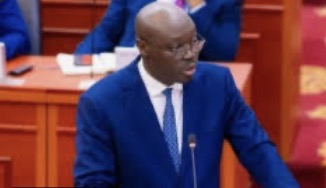
Finance Minister Dr Cassiel Ato Forson on Thursday, November 12, 2026, told Parliament that government will invest GH¢30 billion in its “New Economy” programme in 2027, the first year of a four-year plan worth the equivalent of US$10 billion, with US$3 billion set aside for commercial agriculture.
The figures were announced as Dr Forson presented the 2027 Budget Statement and Economic Policy, titled around the theme “New Economy, New Ghana: Jobs and Prosperity”. The GH¢30 billion allocation for next year is equal to about 1.5% of GDP.
The budget is the first since Ghana completed its IMF programme. The Finance Minister said growth would now be judged by the jobs and incomes it creates, adding that Ghana’s progress “must no longer be measured mainly by growth figures or commodity windfalls.”
GhanaTrends earlier reported that Speaker Bagbin had fixed 6pm on Thursday, November 12 for the 2027 Budget presentation.
GH¢30bn New Economy programme: the eight pillars
The New Economy programme runs from 2027 to 2030. Dr Forson said every project under it will go through appraisal and value-for-money checks, and spending will be budgeted, authorised and reported transparently.
The programme covers eight areas:
- Macroeconomic stability and affordable finance
- Commercial agriculture
- Energy infrastructure
- Mineral value addition
- Tourism and creative arts
- Textiles and garments
- Pharmaceuticals and biomanufacturing
- The technology economy
To create room for the spending, the primary surplus target drops from 1.5% to 0.5% of GDP, while Ghana Revenue Authority tax and compliance measures are expected to bring in an extra 0.5% of GDP.
2027 Budget agriculture plan: US$3bn and four rice hubs
Commercial agriculture receives US$3 billion of the programme. The Minister noted that agriculture makes up about 20% of the economy, nearly 40% of jobs and about 25% of export earnings.
Government plans four rice development hubs, with locations including the Afram Plains, Volta Basin, Western Ghana and Northern Ghana. The targets are:
- 100,000 additional hectares under rice cultivation
- Yields of 5 to 6 tonnes per hectare
- About 125,000 jobs
- An end to commercial rice imports by December 2030
From 2027, rice import licences will be tied to purchases from verified Ghanaian farmers and millers, with import quotas reduced gradually. Tax incentives are planned for irrigation, mechanisation, silos, rice mills, packaging and logistics.
Procurement law will also be amended so that schools, hospitals and other public institutions buy local rice and staples. “If you use Ghana’s money to buy rice, you must buy Ghana rice,” Dr Forson said.
Gold, bauxite and manganese: new local processing rules
The budget sets aside US$1.5 billion for the industrial mineral economy, according to GBC. At least 70% of artisanal and small-scale gold is to be refined locally by end-2027, rising to 100% by December 2028, with raw small-scale gold exports to be banned.
At least 50% of manganese and bauxite is to be processed locally by end-2028, with full local processing targeted for 2030. A 24-hour critical mineral processing enclave is planned for the Western Region.
Construction of a Takoradi Harbour to Nyinahini railway, through Nsuta, Awaso and Twifo Hemang, is to begin in 2027. Government also plans nuclear power as an extra source of baseload electricity.
US$1bn for tourism and the creative arts
Government has earmarked US$1 billion for tourism, culture and the creative arts. Plans include restoring coastal forts and castles, a national events calendar, and a convention bureau to be set up in 2027.
SSNIT will build and operate an international convention centre at the La Trade Fair Centre. “The Black Star Experience will run through all twelve months,” the Minister said.
How the economy compares: 2022 vs 2025
Dr Forson used the budget to set out how far the economy has moved since the 2022 crisis:
- Inflation: 54.1% at end-2022; 5.4% at end-2025 (down from 23.8% at the start of 2025)
- Primary balance: deficit of 4.3% of GDP at end-2022; surplus of 2.5% of GDP at end-2025
- Public debt: 44.7% of GDP at end-2025
- Reserves: under three weeks of import cover at end-2022; 5.7 months at end-2025
2030 targets: 8% growth and unemployment below 8%
The government is targeting real GDP growth of about 8% and unemployment below 8% by 2030, along with a credible path to an investment-grade credit rating. From 2027 it plans a primary surplus of at least 0.5% of GDP, public debt around 45% of GDP and single-digit inflation.
An annual investment-grade readiness report will be published. “An investment-grade sovereign rating cannot be conferred in a speech,” Dr Forson said, adding that it “must be earned through sustained performance.”
What the 2027 Budget means for Ghanaians
For farmers, the budget promises a guaranteed public buyer for local rice and staples, plus tax breaks on equipment and storage. Rice importers face licence conditions and shrinking quotas from next year.
For businesses, government says it will work with Development Bank Ghana and Ghana Exim Bank on credit guarantees, equipment leasing and export finance, with the aim of bringing the cost of capital into single digits. Small-scale miners and mineral exporters will need to plan for the local refining and processing rules.
What happens next
Parliament will now debate the budget before voting to approve it, followed by the Appropriation Bill. The full 2027 Budget Statement is published by the Ministry of Finance.
Details of the GRA revenue measures and the timetable for the procurement law amendment are expected to be clarified during the debate.
Key details at a glance
- Presented: Thursday, November 12, 2026, by Finance Minister Dr Cassiel Ato Forson
- New Economy programme: US$10bn equivalent over 2027–2030; GH¢30bn (1.5% of GDP) in 2027
- Agriculture: US$3bn; four rice hubs; 125,000 jobs; end to commercial rice imports by December 2030
- Minerals: US$1.5bn; 100% local refining of small-scale gold by December 2028
- Tourism and creative arts: US$1bn; convention centre at La Trade Fair Centre
- Targets: 8% GDP growth and unemployment below 8% by 2030
- Primary surplus target cut from 1.5% to at least 0.5% of GDP
FAQs
How much is government investing in the New Economy in 2027?
GH¢30 billion, about 1.5% of GDP, as the first year of a 2027–2030 programme worth the equivalent of US$10 billion.
Will Ghana stop importing rice?
The 2027 Budget targets an end to commercial rice imports by December 2030, with import licences tied to local purchases from 2027 and quotas reduced gradually.
What are the 2027 Budget targets for growth and jobs?
Government is targeting real GDP growth of about 8% and unemployment below 8% by 2030, with single-digit inflation and public debt around 45% of GDP.
The 2027 Budget marks the shift from IMF-backed stabilisation to a spending-led jobs push, with GH¢30 billion committed next year to agriculture, minerals, energy and tourism under the New Economy programme. How quickly the rice, gold and railway plans turn into jobs will be the key test as Parliament begins debating the budget.