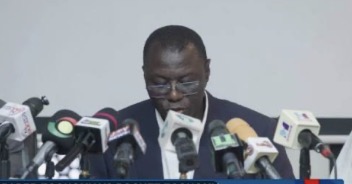
The Minority in Parliament has rejected the 2027 Budget as a “paper economy”, with Minority Leader Alexander Afenyo-Markin saying the government is delivering “stability on paper but hardship in our pockets.” He spoke at a post-budget press conference in Parliament on Thursday, November 12, 2026, shortly after Finance Minister Dr Cassiel Ato Forson presented the budget.
The Minority’s main demands are clear figures on jobs created, funding for public-sector recruitment and pay, and details of how much of the proposed US$10 billion New Economy investment will be spent in 2027.
Dr Ato Forson presented the 2027 Budget Statement and Economic Policy under the theme “The New Economy”, outlining a US$10 billion programme for 2027 to 2030. GhanaTrends earlier reported the key New Economy, agriculture and rice import commitments in the 2027 Budget.
The Minority says it will publish a fuller assessment after Parliament’s budget workshop.
Minority says 2027 Budget offers “stability on paper”
Afenyo-Markin argued that the government’s growth and inflation figures have not lowered the cost of living for ordinary Ghanaians.
“The NDC cannot rebrand unemployment. They cannot slogan away the cost of living,” he said, describing the NDC administration as a “sloganeering government”.
Minority MPs carried placards during the session, some reading “Scam economy” and “Cocaine economy”, according to Graphic Online.
Minority demands jobs figures and recruitment funding
Jobs were at the centre of the Minority’s response. Afenyo-Markin said the government had not told Ghanaians how many jobs it has created since taking office.
“Ghanaians want jobs, jobs, jobs. We are not interested in data,” he said.
He also challenged the Finance Minister’s call for patience. “The minister now tells us that the work ahead will demand patience. Whose patience?” he asked.
He welcomed the government’s commitment to pay Domestic Debt Exchange Programme (DDEP) bondholders, but asked “where is the money to pay JUSAG, the money to pay teachers, the money to pay nurses” and fund recruitment.
Questions over the US$10bn New Economy plan
The Minority wants the government to state how much of the US$10 billion New Economy investment will be available in 2027 and which projects it will fund.
It also asked how the New Economy differs from the 24-hour economy policy the NDC campaigned on.
According to Graphic Online, the caucus further claimed the Big Push infrastructure allocation had been reduced from US$30 billion to US$14 billion without explanation. The government has not yet responded to that claim.
Minority’s key concerns at a glance
- Jobs: no figures on jobs created since the government took office
- Recruitment and pay: funding for JUSAG, teachers, nurses and public-sector hiring
- New Economy: US$10 billion total for 2027–2030, but no 2027 breakdown or project list
- 24-hour economy: unclear link to the New Economy programme
- Women’s bank: campaign promise not addressed in the budget
- Cocoa: criticism of a reduction in the cocoa farmgate price
- Food prices: high prices reported at markets including Techiman, Tamale, Kumasi Asafo, Winneba Central and Makola
Food prices and support for farmers
Afenyo-Markin said the Minority checked prices at several markets and found food still expensive.
Graphic Online reported the caucus saying prices of rice, maize, sorghum and yam have risen over the past two years, and that farmers lack adequate government support to raise output.
Women’s bank missing from the budget
The Minority Leader said the government had failed to deliver on its promise of a bank to give women and traders access to business loans.
He said the women’s bank, which featured in earlier budgets, was not addressed in the 2027 presentation.
What the Minority’s position means for Ghanaians
The Minority’s reaction sets the tone for the budget debate in Parliament. Its focus on jobs, food prices and unpaid public workers reflects issues that affect many households.
For job seekers, teachers, nurses and judicial staff, the debate will test whether the budget has clear funding for recruitment and pay.
Afenyo-Markin also stressed the role of business: “Without the private sector, the economy cannot grow.”
What happens next for the 2027 Budget
Parliament will now debate the budget before voting on it. The Minority says it will hold a budget workshop and publish a detailed assessment afterwards.
The full budget statement is available from the Ministry of Finance.
Key details at a glance
- Minority Leader Alexander Afenyo-Markin called the 2027 Budget a “paper economy”.
- The reaction came on November 12, 2026, after Dr Cassiel Ato Forson presented the budget.
- The Minority wants figures on jobs created since the government took office.
- It asked how much of the US$10bn New Economy plan will be spent in 2027.
- It questioned funding for JUSAG, teachers, nurses and recruitment.
- It said the promised women’s bank was missing from the budget.
- A full Minority assessment will follow its budget workshop.
FAQs
What did the Minority say about the 2027 Budget?
Minority Leader Alexander Afenyo-Markin described it as a “paper economy” that offers “stability on paper but hardship in our pockets”, and demanded figures on jobs and recruitment funding.
How much is the New Economy plan in the 2027 Budget?
The government outlined a US$10 billion New Economy programme for 2027 to 2030. The Minority wants to know how much of it will be spent in 2027.
When will the Minority release its full budget assessment?
The Minority says it will publish a detailed assessment after Parliament’s budget workshop. No date has been announced.
The Minority has drawn a clear line ahead of the budget debate: it accepts that the government has stabilised key figures, but insists Ghanaians have not felt it in jobs, food prices or pay. How the Finance Minister answers questions on the US$10bn New Economy plan and recruitment funding will shape the debate in the coming days.