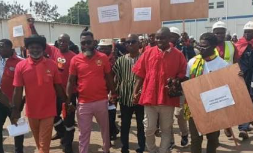
The General Transport, Petroleum and Chemical Workers’ Union (GTPCWU) of the TUC has threatened a nationwide strike across Ghana’s downstream petroleum sector if Parliament passes the National Petroleum Authority (NPA) Bill, 2026, in its current form. The union announced the position on Monday, November 23, 2026, at a press conference at BOSTenergies’ premises in Kpone.
At the centre of the dispute is Clause 103 of the Bill, which would end the Bulk Oil Storage and Transportation Company’s (BOST) exclusive mandate to develop, operate and maintain inland petroleum depots and open that role to private operators.
Union Chairman Bernard Owusu said that if the concerns are not addressed, the union will mobilise members at BOST and across the downstream petroleum sector, and may take “further industrial actions with dates to be announced.”
No strike date has been fixed. The threat is tied to Parliament passing the Bill without changes to Clause 103.
Why petroleum workers oppose Clause 103 of the NPA Bill
The union says it is not against private participation in the downstream petroleum industry. Instead, it wants private operators to partner BOST under the Public-Private Partnership Act, 2020 (Act 1039), rather than compete directly for the inland depot mandate.
According to the union, the Bill opens BOST’s role to competitors while still limiting BOST to selling only to bulk distribution companies (BIDECs). It argues this denies the state firm the same commercial freedom its private rivals would enjoy.
The union also warns that private depot operators answer mainly to shareholders, while BOST carries a national mandate, including supplying the strategic fuel reserve and serving northern Ghana.
BOST jobs at risk: workforce figures cited by the union
The union says BOST has expanded its permanent staff in recent years, partly to support the government’s 24-Hour Economy programme. It warns that private competition could force the company to cut its workforce by almost half.
- BOST permanent workforce in 2024: 440
- BOST permanent workforce by November 2025: 743
- New permanent unionised jobs added: 303
- Union warning: workforce could be cut by almost half under private competition
The union further argues that billions of cedis in public funds and sovereign-backed debt have gone into national depots, pipelines and terminals, and that this investment could be undermined.
How the union engaged government on the NPA Bill 2026
The GTPCWU says it petitioned President John Dramani Mahama in August, submitted memoranda to Parliament, met the Minister for Energy and Green Transition and offered drafting proposals.
Despite this, the union says the Bill was resubmitted to Parliament without changes addressing its concerns, and that consultations have not shifted the Ministry’s position.
The union’s five demands
- Revise Clause 103 to keep BOST’s exclusive mandate over inland depots.
- Release the final stakeholder engagement report on the Bill.
- Create a level playing field, including allowing BOST to sell directly to Oil Marketing Companies (OMCs).
- Approve no private inland depots until the issues are resolved.
- Publish the Ministry’s impact assessment of the Bill.
What a petroleum strike could mean for fuel consumers
BOST manages much of Ghana’s inland fuel storage and transport network, so industrial action by depot and downstream workers could disrupt fuel distribution if it goes ahead.
The union also flagged risks of higher costs for the strategic fuel reserve and supply challenges in northern Ghana if depot operations shift to private hands. Pump prices are already being watched closely after the NPA’s latest price floor adjustment for petrol, diesel and LPG.
The union says anyone who pushes the Bill through without addressing workers’ concerns would bear responsibility for any disruption that follows.
What happens next
The NPA Bill, 2026, is before Parliament. The union’s next step depends on whether lawmakers amend Clause 103 before passing it.
As of the union’s announcement, no public response from the Ministry of Energy and Green Transition, the National Petroleum Authority or BOST management had been reported in the coverage reviewed. Strike dates, if any, will be announced by the union.
Key details at a glance
- Union: General Transport, Petroleum and Chemical Workers’ Union (GTPCWU) of the TUC
- Bill: National Petroleum Authority (NPA) Bill, 2026
- Contested provision: Clause 103 – ends BOST’s exclusive inland depot mandate
- Announced: Monday, November 23, 2026, at BOSTenergies, Kpone
- Threat: nationwide strike across BOST and the downstream petroleum sector
- BOST staff: rose from 440 (2024) to 743 (November 2025)
- Strike date: not yet announced
FAQs
Why are petroleum workers threatening a strike in Ghana?
The GTPCWU opposes Clause 103 of the NPA Bill, 2026, which would end BOST’s exclusive mandate over inland fuel depots and open the role to private operators. The union says this threatens jobs and energy security.
When will the petroleum workers’ strike start?
No date has been set. The union says it will strike if Parliament passes the Bill unchanged, with dates to be announced.
What is Clause 103 of the NPA Bill 2026?
Clause 103 would remove BOST’s exclusive right to develop, operate and maintain inland petroleum depots, allowing private companies to take on that role.
The petroleum workers’ threat puts fresh pressure on Parliament and the Energy Ministry over the NPA Bill, 2026. With the union insisting Clause 103 be revised to protect BOST’s depot mandate and 743 jobs, the next steps in Parliament will decide whether Ghana’s downstream fuel sector faces industrial action.