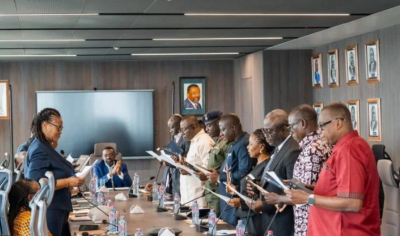
The Bank of Ghana (BoG) has inaugurated a multi-agency committee to investigate foreign currency seized at Ghana’s airports and border points as authorities intensify efforts to tackle the movement of undeclared cash outside the formal financial system.
The Preliminary Investigation Committee on Seized Foreign Currency was inaugurated on Saturday, August 29, as part of efforts to strengthen how authorities monitor, investigate and account for foreign currency intercepted at Ghana’s borders.
Bank of Ghana Governor Dr Johnson Pandit Asiama said substantial amounts of foreign currency were reportedly being moved through the country’s airports and border points without the required declarations.
Undeclared currency flows create room for money laundering, tax evasion and other illicit activity, he said.
According to the Governor, the movement of undeclared foreign currency creates risks for Ghana’s financial system and can provide opportunities for money laundering, tax evasion and other illicit financial activity.
BoG Launches Probe Into Seized Foreign Currency – Further Details
The new BoG foreign currency probe is intended to address what the central bank considers a significant gap in Ghana’s financial monitoring system.
The committee will focus on foreign currency seized by authorities and examine how such cases are handled and investigated.
The initiative is expected to improve coordination among the institutions responsible for detecting, securing and investigating undeclared foreign currency.
The central bank says the ultimate objective is to strengthen the integrity of Ghana’s financial system and improve the flow of financial intelligence available to authorities.
Why undeclared forex is a concern
Foreign currency entering or leaving Ghana outside the required declaration process can make it more difficult for regulators and security agencies to understand the movement of funds.
Dr Asiama said such flows weaken the financial intelligence available to authorities monitoring the financial system.
He also warned that currency moving outside declared channels can divert funds away from Ghana’s formal financial market.
That creates challenges for authorities seeking to monitor foreign exchange activity and maintain a clearer picture of the country’s financial flows.
Multiple agencies join the investigation
The Bank of Ghana is not conducting the exercise alone.
The committee brings together several state institutions with responsibilities relating to financial regulation, border security, taxation and criminal investigations.
The agencies involved include the Ghana Revenue Authority (GRA), Ghana Airports Company Limited, National Security, the Economic and Organised Crime Office (EOCO), the Financial Intelligence Centre (FIC) and the Attorney General’s Office.
The multi-agency structure is designed to allow information gathered by one institution to be shared with others responsible for investigating potential financial offences.
This could help authorities identify patterns that may not be visible when border seizures are handled in isolation.
Probe goes beyond airports
Although airports are an important focus, the initiative also covers Ghana’s wider border points.
The central bank has raised concerns about undeclared foreign currency moving through both airports and land borders.
The development places greater emphasis on the country’s ability to monitor cash movements at entry and exit points.
Effective enforcement could also help authorities distinguish legitimate foreign-currency movement from transactions that require further investigation.
What could the probe uncover?
The committee’s work could provide authorities with a clearer understanding of the scale and nature of foreign currency seizures in Ghana.
However, no specific amount of seized foreign currency has been disclosed by the Bank of Ghana in the reports reviewed.
It would therefore be premature to conclude that a particular volume of money is involved or that the seized funds are connected to criminal activity.
The committee’s mandate is investigative, meaning the circumstances surrounding individual seizures will need to be established before conclusions can be drawn.
Money laundering and tax concerns
The Bank of Ghana has specifically identified money laundering and tax evasion among the risks associated with undeclared foreign currency flows.
Cash movements outside formal channels can make it harder for financial intelligence agencies to trace the origin and destination of funds.
For regulators, improving the reporting and investigation process could therefore strengthen Ghana’s wider anti-money-laundering framework.
The initiative also highlights the growing importance of cooperation between financial regulators, border agencies and law-enforcement institutions.
Protecting the formal foreign exchange market
The BoG has been working to strengthen Ghana’s formal foreign exchange market and improve monitoring of foreign-currency transactions.
The Governor said currency moved outside declared channels can divert funds away from the formal market, potentially making it more difficult for authorities to monitor foreign exchange activity.
For a country where foreign exchange availability and exchange-rate stability remain important economic issues, better visibility over currency flows is particularly significant.
However, the new investigation should be distinguished from routine foreign-exchange regulation. Its immediate focus is on seized foreign currency and the systems used to investigate such seizures.
What happens next?
The committee is expected to examine the cases of seized foreign currency and help strengthen the processes surrounding such seizures.
The involvement of the GRA, National Security, EOCO, FIC and other agencies could allow authorities to combine financial, tax, security and legal expertise.
The effectiveness of the exercise will ultimately depend on whether it produces stronger monitoring mechanisms and improves the way seized currency cases are investigated and resolved.
For now, the Bank of Ghana says the initiative is part of a broader effort to protect Ghana’s borders, financial markets and resources.
BoG Launches Probe Into Seized Foreign Currency – Key details at a glance
- Institution leading the initiative: Bank of Ghana.
- Committee: Preliminary Investigation Committee on Seized Foreign Currency.
- Focus: Foreign currency seized at airports and border points.
- BoG Governor: Dr Johnson Pandit Asiama.
- Key concerns: Money laundering, tax evasion and illicit financial activity.
- Agencies involved: BoG, GRA, Ghana Airports Company, National Security, EOCO, FIC and Attorney General’s Office.
- Date announced: August 29, 2026.
- Specific amount seized: Not disclosed in the reports reviewed.
FAQ
Why is the Bank of Ghana investigating seized foreign currency?
The BoG says substantial amounts of foreign currency are reportedly being moved through Ghana’s airports and border points without the required declarations, creating risks including money laundering and tax evasion.
Which agencies are involved in the foreign currency probe?
The initiative involves the Bank of Ghana, Ghana Revenue Authority, Ghana Airports Company Limited, National Security, EOCO, the Financial Intelligence Centre and the Attorney General’s Office.
How much foreign currency has Ghana seized?
The Bank of Ghana has not disclosed a specific total amount in the reports announcing the committee. The central bank has only said substantial amounts of foreign currency are reportedly moving through the borders without the required declaration.
The Bank of Ghana’s decision to establish the Preliminary Investigation Committee on Seized Foreign Currency marks a new step in Ghana’s efforts to strengthen oversight of cash movements across its borders. The key question now is whether the multi-agency investigation will lead to stronger monitoring, better financial intelligence and more effective enforcement against illicit financial flows.
More trending news on GhanaTrends
More on the story: MyJoyOnline BoG report