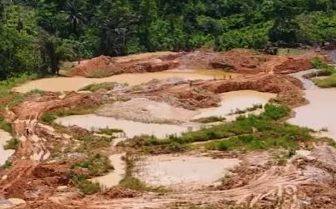
Cadmium levels exceeded safety guidelines in every soil sample tested from artisanal and small-scale gold mining areas in Ghana’s Savannah Region, while mercury was above recommended limits in about 94% of samples, according to three baseline studies funded by the European Union under the Gold for Good (G4G) Project.
The studies, launched in Accra on Thursday, November 5, 2026, also found that only 2.92% of respondents held mining licences and about 74% did not know the laws governing mining in their communities.
The research covered West Gonja Municipality, Bole District and Sawla-Tuna-Kalba District along the Black Volta corridor. It surveyed 953 respondents across 30 communities and mapped 94 mining sites.
The findings are back in the headlines today, with the Ghanaian Times leading its Wednesday, November 11 edition with the report under the headline “EU study exposes gaps in fight against galamsey”.
Cadmium and mercury contamination in Savannah mining soils
The ecological and health risk assessment found that cadmium exceeded international guideline values in all soil samples collected. Mercury was above recommended thresholds in about 94% of samples.
According to the GNA report on the launch, 68.64% of mapped mining areas fell into the critical environmental-risk category, and contaminated soil was the main way people were exposed.
Deputy Minister of Lands and Natural Resources, Alhaji Yusif Sulemana, said soil where children play contained cadmium at more than 40 times the safe limit.
Children and women face higher galamsey health risks
The study found that 46% of children’s exposure scenarios exceeded acceptable non-carcinogenic health-risk thresholds, compared with 20% for adults. Cadmium accounted for more than three-quarters of the assessed health hazard.
Women faced higher exposure through ore processing and handling contaminated materials, while children were at risk through contact with polluted soil and living close to gold-processing sites.
Heavy metal pollution from illegal mining has been linked to wider health concerns in Ghana, including a reported rise in kidney cases among children.
Galamsey study figures at a glance
- Respondents surveyed: 953 across 30 communities
- Mining sites mapped: 94
- Soil samples with cadmium above guidelines: 100%
- Soil samples with mercury above limits: about 94%
- Mapped mining areas at critical environmental risk: 68.64%
- Respondents holding mining licences: 2.92%
- Respondents unaware of mining regulations: about 74%
- Respondents with registered land: 15.96%
- Gold transactions done in cash: 98.33%
Mining income nearly six times higher, but rules widely unknown
Households in mining communities reported average earnings almost six times those of households in non-mining communities, which researchers say makes mining attractive despite its risks.
The near-total reliance on cash for gold sales (98.33% of transactions) raises traceability and oversight concerns, the study found.
“For years, we debated galamsey with great passion and very little data. Today, that changes,” Alhaji Yusif Sulemana said at the launch. He noted that three in four people in the corridor were “breaking rules they have never been told exist.”
Security concerns along the Black Volta border
The studies identified unregulated mining along the Black Volta tri-border frontier, which links Ghana with Côte d’Ivoire and Burkina Faso, as a security concern.
Rev. Fr. Dr. Clement Aapengnuo, Country Director of Coginta Ghana and Team Leader of the G4G Project, pointed to migrant networks, cash-based gold trading and armed informal security groups in areas where state presence is limited.
“Enforcement alone will not secure this border,” he said, adding: “Bringing mining within the law, with communities and traditional authorities as partners, will.”
What the EU and government officials said
EU Ambassador to Ghana Rune Skinnebach said the project aims to help Ghana build a small-scale mining sector that is lawful, environmentally responsible, socially inclusive and economically beneficial to communities.
Deputy Head of the EU Delegation, Jonas Claes, said the research showed a significant gap between Ghana’s mining laws and their implementation, and called for sustained public education on the long-term costs of illegal mining.
What it means for mining communities
For residents of West Gonja, Bole and Sawla-Tuna-Kalba, the findings point to health risks from contaminated soil, especially for children and women who process ore.
The low licensing rate and limited awareness of the rules also suggest many miners operate outside the law without fully understanding it, which researchers say complicates enforcement.
What happens next for the Gold for Good Project
The €3 million, 18-month G4G Project is implemented by Coginta and funded by the EU. The findings will guide its next phase, focused on institutional coordination, conflict prevention, formalising miners, responsible gold sourcing and rehabilitating degraded land.
Dollar Power and Tinga in the Bole District were named priority communities for integrated interventions. Together they account for 59 mapped sites classified as critical environmental risk.
Recommendations include mandatory backfilling of abandoned pits, dust suppression, protection of indigenous trees, mercury-free gold processing and greater involvement of women, youth and migrant miners in decision-making. Full launch report (MyJoyOnline).
Quick Summary – EU Study Finds Cadmium Above Safe Limits in All Soil Samples From Savannah Galamsey Areas, Only 2.92% of Miners Licensed
- Studies funded by the EU under the €3m Gold for Good Project, implemented by Coginta
- Covered West Gonja, Bole and Sawla-Tuna-Kalba in the Savannah Region
- Cadmium exceeded guidelines in all soil samples; mercury in about 94%
- Only 2.92% of respondents held mining licences
- About 74% were unaware of mining regulations
- Mining households earn almost six times more than non-mining households
- Dollar Power and Tinga named priority intervention communities
FAQs on Story: EU Study Finds Cadmium Above Safe Limits in All Soil Samples From Savannah Galamsey Areas, Only 2.92% of Miners Licensed
What did the EU galamsey study in the Savannah Region find?
It found cadmium above safety guidelines in all soil samples and mercury above limits in about 94%. Only 2.92% of respondents had mining licences and about 74% did not know the mining rules.
Which districts were covered by the Gold for Good study?
The studies covered West Gonja Municipality, Bole District and Sawla-Tuna-Kalba District in the Savannah Region, along the Black Volta corridor.
Why is cadmium in soil dangerous?
The World Health Organization classifies cadmium as a human carcinogen. It builds up in the body over time and can damage the kidneys and weaken bones.
The EU-funded studies give Ghana fresh data on galamsey in the Savannah Region: widespread heavy metal contamination, very low licensing and limited awareness of the law. Officials say the next phase of the Gold for Good Project will focus on formalising miners, rehabilitating land and working with communities and traditional authorities alongside enforcement.