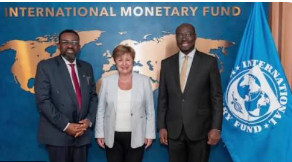
The International Monetary Fund (IMF) says Ghana is now reaping the gains of the difficult economic reforms it undertook after its debt crisis, with growth of 6% last year, single-digit inflation and public debt down to about 50% of GDP. The Fund, however, warns that the country’s next task is to protect those gains and build resilience against future shocks.
The assessment was given by Julie Kozack, the IMF’s Director of Communications, at a press briefing in Washington, DC, reported by Ghanaian media on Monday, November 16, 2026.
Kozack said Ghana’s reforms are beginning to produce results and that the Fund’s engagement with the country is shifting from crisis management to supporting long-term reforms.
The comments come just days after Finance Minister Dr Cassiel Ato Forson presented the 2027 Budget Statement to Parliament.
IMF says Ghana’s fiscal position is now strong
Kozack said Ghana’s public finances have improved significantly since the crisis years.
“The fiscal position in Ghana is now strong, and the primary surplus is on track to meet the year-end targets,” she said.
She also credited the government for taking hard decisions. “We’ve also seen a willingness by the authorities to undertake some very difficult policy decisions,” she added.
Kozack praised what she described as “extensive social dialogue” with stakeholders outside government to explain the reforms and gather feedback.
Ghana economy figures: growth, inflation and debt
According to the IMF, Ghana’s key economic indicators have improved as follows:
- Economic growth (last year): 6%
- IMF growth projection (this year): 5.7%
- Inflation: single digits (5.5% in October 2026, per the Ghana Statistical Service)
- Public debt: about 50% of GDP
- Primary balance: surplus on track to meet year-end targets
- Government debt target: 45% of GDP
The IMF had earlier raised its 2026 growth forecast for Ghana to 5.7%, as GhanaTrends reported in October.
From US$3bn bailout to Policy Coordination Instrument
Ghana completed its three-year, US$3 billion Extended Credit Facility (ECF) programme in July 2026, when the IMF Executive Board approved the sixth and final review and released a final disbursement of about US$371 million.
The country has since moved to a 36-month Policy Coordination Instrument (PCI). Unlike the ECF, the PCI provides no money, but it keeps IMF monitoring of policies and is seen as a signal of confidence to investors and lenders.
Details of the arrangement are set out in the IMF’s official press release.
“It was a hard time for the people”
Kozack acknowledged the pain Ghanaians went through during the crisis that led to the bailout.
“It was a hard time for the country; it was a hard time for the people,” she said.
She stressed that the focus now must be on not losing the progress made. “The focus is really on strengthening and bolstering that resilience that comes next for the country,” she said.
How the IMF view compares with the 2027 Budget targets
In the 2027 Budget, Dr Ato Forson set targets that include keeping inflation in single digits, lowering the cost of borrowing and bringing public debt down to 45% of GDP.
With the IMF putting debt at around 50% of GDP, further reduction of about five percentage points is still needed to hit the government’s target.
Inflation, though still in single digits, has edged up for three straight months, rising to 5.5% in October from 5.2% in September.
What the IMF assessment means for Ghanaians
For households and businesses, single-digit inflation and a stronger fiscal position mean more stable prices and a better chance of lower interest rates on loans.
A positive IMF view can also boost investor confidence, which supports the cedi and makes it easier for government to borrow at better rates.
However, the Fund’s warning about resilience means shocks such as energy-price pressures could still threaten the gains if buffers are not built.
What happens next
Parliament is currently scrutinising the 2027 Budget proposals, which will set out how government plans to sustain the recovery.
Under the PCI, the IMF will continue to review Ghana’s policies periodically, with debt reduction and protection against external shocks expected to remain key areas of focus.
Key details at a glance
- IMF says Ghana is reaping gains from tough reforms.
- Statement by Julie Kozack, IMF Director of Communications, in Washington, DC.
- Ghana’s economy grew 6% last year; IMF projects 5.7% this year.
- Public debt is about 50% of GDP; government targets 45%.
- Primary surplus is on track to meet year-end targets.
- Ghana exited the US$3bn ECF in July 2026 and is now on a 36-month PCI.
- IMF says the next priority is building resilience against future shocks.
FAQs
What did the IMF say about Ghana’s economy?
The IMF said Ghana is reaping gains from tough reforms, with 6% growth last year, single-digit inflation, a strong fiscal position and public debt of about 50% of GDP.
Is Ghana still under an IMF programme?
Ghana completed its US$3 billion ECF bailout in July 2026 and moved to a 36-month Policy Coordination Instrument, which provides no funding but keeps IMF monitoring of policies.
What is Ghana’s debt-to-GDP ratio in 2026?
According to the IMF, Ghana’s public debt is about 50% of GDP, while the government is targeting 45% of GDP.
The IMF’s latest assessment confirms that Ghana’s economy has turned the corner since the debt crisis, with stronger growth, low inflation and falling debt. But the Fund’s message is clear: the hard part now is protecting those gains, cutting debt further and building buffers so that future shocks do not undo the recovery.