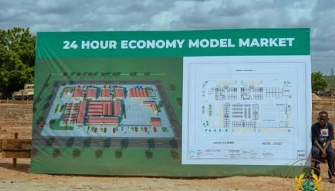
The government has renamed its flagship 24-hour economy markets project as District Economy Markets, with the aim of completing the markets in all 261 Metropolitan, Municipal and District Assemblies (MMDAs) by 2028. Local Government, Chieftaincy and Religious Affairs Minister Mahama Ayariga announced the change at the Government Accountability Series in Accra on Monday, October 5, 2026.
Mr Ayariga said the old label had given Ghanaians the wrong idea about the government’s broader 24-hour economy agenda. “The use of the 24-hour economy markets has tended to create the impression that the whole thing about the government’s flagship programme of 24-hour economy is about markets,” he said.
Some outlets, including MyJoyOnline, reported the new name as “District Model Markets”. Citi Newsroom and Adom Online quoted the minister using “District Economy Markets”.
The minister also said the project is being reviewed to fit the money available. “Deliberations are ongoing with a view to remodelling the designs and rescoping the project to fit readily available budget and urgent need to complete the markets within two years,” he said.
Why the 24-hour economy markets were renamed
The 24-hour economy is one of President John Dramani Mahama’s main policies. It is meant to boost production, jobs and services around the clock, not only trading.
According to Mr Ayariga, calling the district projects “24-hour economy markets” made some people think the whole policy was only about building markets. The new name ties the projects to local economic activity in each district instead. Readers can catch up on the wider policy in our report on 24-Hour Economy Securing $5.5bn in Project Commitments.
District Economy Markets to be built in two phases
Citi Newsroom reports that the project has now been split into two phases:
- Phase 1: Market stores, sheds and other commercial spaces.
- Phase 2: Supporting facilities such as police and fire stations, paid for from future District Assemblies Common Fund (DACF) allocations.
The government says the aim is to give every district modern trading infrastructure that supports local businesses.
Where the district market projects stand
President Mahama has already cut sods for market projects across the country, and construction is at different stages in seven regions, according to MyJoyOnline.
Mr Ayariga also said negotiations have been completed for contractors to return to two stalled projects: the Kumasi Central Market Phase II and the Takoradi Market Circle.
Common Fund and district projects: key figures
At the same briefing, the minister gave an update on money sent to the assemblies and projects funded from it, as reported by 3News:
- DACF released: GH¢9.1 billion, covering six quarters
- CHPS compounds/health centres: 397 of 566 completed
- Classroom blocks: 502 of 761 completed
- Boreholes: 3,081 of 4,029 completed
- Small-town water projects: 97 of 134 completed
Earlier ministry guidelines reported by the Ghanaian Times set aside 25% of each assembly’s Common Fund allocation for the model markets, with contracts awarded for markets in all 261 districts.
Other announcements at the Government Accountability Series
Mr Ayariga used the session to outline several other local government measures:
- Aayalolo contra-flow: President Mahama is satisfied with early results of the bus contra-flow trial in Accra, which began on September 29, and will meet stakeholders this week on making it permanent.
- Chiefs’ allowances: Monthly allowances for Paramount Chiefs and Queen Mothers, raised from GH¢1,200 to GH¢3,000, have been paid for six quarters, MyJoyOnline reported.
- Digital property rates: A new platform will collect property rates through mobile money and bank transfers to reduce leakages and raise more revenue for assemblies.
The ministry’s mandate and structure are outlined on the Information Services Department profile of the Ministry of Local Government, Chieftaincy and Religious Affairs.
What the District Economy Markets mean for traders
For traders in district capitals, the plan promises new stores, sheds and commercial space, with security and fire services to follow in a second phase.
The redesign to fit the budget could, however, change the size or look of some markets compared with earlier plans. Traders waiting on stalled projects in Kumasi and Takoradi may see work resume after the deal with contractors.
What happens next
The ministry is still reviewing designs and the scope of the project. The government has set 2028 as the target for completing markets in all 261 districts, which is about two years from now.
Phase 2 facilities will depend on future Common Fund releases. Details of the revised designs and costs have not yet been announced.
24-Hour Economy Markets Renamed District Economy Markets, All 261 Districts Targeted by 2028 – Key details at a glance
- New name: District Economy Markets (some outlets report “District Model Markets”)
- Old name: 24-hour economy markets / 24-hour model markets
- Announced by: Local Government Minister Mahama Ayariga, October 5, 2026
- Coverage: All 261 MMDAs
- Completion target: 2028 (within two years)
- Phase 2 funding: Future DACF allocations
- Stalled projects resuming: Kumasi Central Market Phase II, Takoradi Market Circle
FAQs on 24-Hour Economy Markets
Why were the 24-hour economy markets renamed?
Mr Ayariga said the old name made people think the whole 24-hour economy policy was only about markets. The new name links the projects to district-level economic activity.
When will the District Economy Markets be completed?
The government is targeting completion in all 261 districts by 2028, within about two years.
How will the District Economy Markets be funded?
The markets are funded through the District Assemblies Common Fund, and Phase 2 facilities such as police and fire stations will be paid for from future DACF allocations.
The rename of the 24-hour economy markets to District Economy Markets signals a reset of one of the government’s most visible district projects, with smaller, budget-fitted designs, a two-phase plan and a 2028 deadline for all 261 assemblies. How quickly the redesigned markets move from sod-cutting to trading will be the real test.