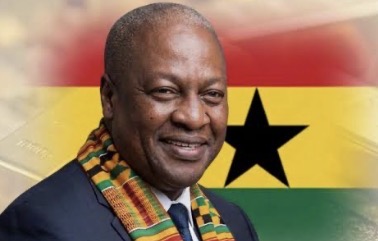
Ghana has collected GH¢7.8 billion in royalties from large-scale gold mining companies since it replaced fixed 3% royalties with a sliding-scale regime, President John Dramani Mahama has said.
The President disclosed the figure while speaking at the West Africa Integration and Investment Summit (WAIIS) in Sierra Leone, where he urged African governments to review mineral agreements so that resource wealth benefits their own people.
Under the new system, royalties on large-scale gold mining move with international gold prices, from a minimum of 5% when prices are low to 12% when prices are high. Mahama said gold prices have stayed high since the law was passed, so Ghana is currently collecting the top rate of 12%.
The inaugural WAIIS, convened by Sierra Leone’s President Julius Maada Bio, runs from November 16 to 18, 2026, and brings together heads of state, ministers, investors and development finance institutions, according to Citi Newsroom.
Gold royalties rise from fixed 3% to sliding scale of up to 12%
Before the reform, Ghana’s royalties from big gold miners were locked at 3% under development and stability agreements signed with the companies.
“So we signed the development agreements and locked in the royalty at 3%,” Mahama said, explaining why the country moved to a price-linked system.
The Minerals and Mining Royalty Regulations, 2025 were laid before Parliament on December 19, 2025, and had matured into law by March 2026. The new regime took effect this year.
How the new gold royalty rates compare
- Old regime: fixed royalty of 3% under development and stability agreements
- New regime (low gold prices): minimum royalty of 5%
- New regime (high gold prices): maximum royalty of 12%
- Rate currently applied: 12%, according to the President, because gold prices remain high
- Royalties collected so far: GH¢7.8 billion from large-scale gold miners
Gold Board boosts small-scale gold output to 104 tonnes
Mahama also pointed to the Ghana Gold Board (GoldBod) as another policy that keeps more value from gold in the country.
He said gold output from the artisanal and small-scale sector rose from 64 tonnes, valued at US$4.6 billion, in 2024 to 104 tonnes, worth US$10.8 billion, after the Gold Board law was introduced.
- 2024 small-scale output: 64 tonnes, valued at US$4.6 billion
- After Gold Board law: 104 tonnes, valued at US$10.8 billion
- Increase: 40 tonnes, with value rising by US$6.2 billion
The law requires all gold exports to pass through the Gold Board. Anyone who breaks it risks having the gold confiscated and could face imprisonment. GhanaTrends earlier reported that GoldBod earned US$1.011 billion in forex in October and set a US$1.2 billion target for November.
Mahama urges African countries to renegotiate mineral deals
At the summit, the President called on African countries to review existing mining agreements and take greater control of their natural resources.
He argued that mining wealth should stay with African communities rather than build up largely outside the continent, and that minerals should create jobs, investment and better living conditions where mining takes place.
“African minerals must be a source of wealth and prosperity for African people,” Mahama said.
What the GH¢7.8bn gold royalty haul means for Ghanaians
Royalties are paid to the state, so higher rates mean more revenue flowing to government from the same gold being mined.
With gold prices high, the jump from 3% to 12% means the state now takes a far bigger share of the value of gold produced by large miners than it did under the old agreements.
The sliding scale also works in reverse: if gold prices fall, the rate drops towards the 5% floor, so royalty income would shrink.
What happens next
The royalty rate will keep adjusting with international gold prices, so future collections will depend largely on where gold prices go.
Mahama’s call for mineral deals to be renegotiated is likely to feature in follow-up discussions after the summit, whose organisers say commitments made will be tracked by the WAIIS Secretariat.
Key details at a glance
- Ghana has earned GH¢7.8 billion in royalties from large-scale gold miners under the sliding-scale regime.
- Royalties were previously fixed at 3% under development and stability agreements.
- The new rates range from 5% at low gold prices to 12% at high prices.
- Ghana is currently collecting the 12% top rate, Mahama said.
- Small-scale gold output rose from 64 tonnes (US$4.6bn) in 2024 to 104 tonnes (US$10.8bn).
- All gold exports must go through the Ghana Gold Board.
- Mahama spoke at the West Africa Integration and Investment Summit in Sierra Leone.
FAQs
How much has Ghana earned from the sliding-scale gold royalty?
President Mahama says Ghana has collected GH¢7.8 billion in royalties from large-scale gold mining companies since the sliding-scale regime took effect.
What is Ghana’s new gold royalty rate?
Royalties now range from 5% when gold prices are low to 12% when prices are high. Ghana is currently collecting 12% because gold prices remain high.
What was Ghana’s gold royalty rate before the sliding scale?
Large-scale gold miners paid a fixed royalty of 3%, which had been locked in under development and stability agreements.
Ghana’s switch from a fixed 3% royalty to a price-linked rate of up to 12% has brought in GH¢7.8 billion from large-scale gold miners, according to President Mahama, who used the figure at the West Africa Integration and Investment Summit to press other African countries to renegotiate mineral deals and keep more of their resource wealth at home.