Ghana has secured US$3.5 billion in investment commitments to expand upstream petroleum operations and drill new wells, Energy and Green Transition Minister Dr John Abdulai Jinapor has announced. He also said the country’s crude oil production has risen by about 30% this year, reversing five years of decline.
The minister made the disclosures during a fireside chat at the opening ceremony of African Energy Week (AEW) 2026 in Cape Town, South Africa. He shared the stage with Kosmos Energy Chief Executive Officer Andrew Inglis, while African Energy Chamber Executive Chairman NJ Ayuk moderated the session.
“We have seen a continued systematic decline in oil output over the past five years,” Dr Jinapor said, adding that the trend has been turned around in 2026.
He credited the gains to sustained engagement with investors and ongoing legal and fiscal reforms aimed at making Ghana’s oil and gas sector more attractive.
Ghana secures US$3.5bn in upstream oil investment commitments
According to the minister, the US$3.5 billion in commitments will go into expanding existing operations and drilling new wells.
The names of the investors behind the commitments and their individual amounts were not disclosed.
“We are working to establish a more competitive, predictable and business-friendly environment,” Dr Jinapor said, while stressing that the reforms must protect Ghana’s national interests.
Ghana crude oil production up 30% after five-year decline
Dr Jinapor said national crude oil output has risen by about 30% this year, after a steady fall since around 2020.
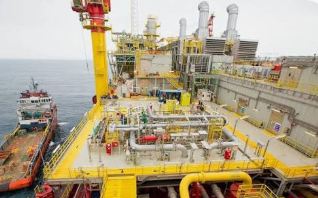
Much of the recovery has come from the Jubilee field, Ghana’s largest producing asset. Jubilee averaged about 72,000 barrels per day (gross) in the second quarter of 2026, according to Kosmos Energy’s August results.
Two new wells, J76 and J77, came on stream in June and July 2026 respectively.
How the Kosmos US$2bn Jubilee deal changed the picture
The production rebound follows a US$2 billion memorandum of understanding signed with Jubilee partner Kosmos Energy in 2025.
That agreement extended the Jubilee and TEN licences to 2040 and unlocked an amended Jubilee development plan covering up to 20 additional wells, with a focus on higher gas volumes for domestic power generation.
Mr Inglis said the licence extension gave Kosmos the confidence to invest, particularly in technology. “We agreed to supply low-cost gas to the country,” he said, adding that energy security “also comes down to energy affordability.”
The development comes shortly after Jubilee and TEN crude began flowing to local refineries — see our earlier report: Tullow Starts Selling Jubilee, TEN Crude to Ghanaian Refineries, Targets 14 Cargoes in 2026.
Ghana oil sector figures at a glance
- Investment commitments secured: US$3.5 billion
- Change in national crude output in 2026: up about 30%
- Jubilee average output, Q2 2026: about 72,000 barrels per day (gross)
- Kosmos MoU signed in 2025: US$2 billion
- Jubilee and TEN licence expiry: extended to 2040
- Additional wells under amended Jubilee plan: up to 20
- Next drilling campaign: up to 10 wells in 2027–2028, starting mid-2027
- Kosmos 2026 group capital budget: US$350 million
Fiscal reforms, Chevron, Shell and CNOOC talks
Dr Jinapor said the government is revising Ghana’s petroleum fiscal regime to make upstream investment more competitive.
He said both he and the Finance Minister have approved the changes, which will next go to Cabinet and then to Parliament.
Ghana plans to sign an agreement with Chevron once Parliament approves the reforms. The minister also said talks are ongoing with Shell, CNOOC and Petrobras.
What higher oil output means for Ghanaians
Dr Jinapor said attracting investment alone is not enough and that petroleum resources must deliver lasting benefits for Ghanaians.
The government wants to increase local participation, deepen domestic value addition and expand local refining capacity so more Ghanaian crude is processed at home.
He said this could boost industrial activity, create jobs and improve energy security. More gas from Jubilee is also expected to support cheaper domestic power generation.
What happens next
The revised fiscal regime is expected to go before Cabinet and then Parliament for approval, after which the Chevron agreement is to be signed.
Jubilee partners are seeking a rig for a drilling campaign of up to 10 wells in 2027–2028, expected to begin in mid-2027, according to Kosmos.
Updates on the sector are expected from the Ministry of Energy and Green Transition.
Key details at a glance
- Ghana has secured US$3.5bn in commitments to expand upstream operations and drill new wells.
- National crude output is up about 30% in 2026 after five years of decline.
- Jinapor spoke at African Energy Week 2026 in Cape Town alongside Kosmos CEO Andrew Inglis.
- Jubilee averaged about 72,000 bpd gross in Q2 2026; wells J76 and J77 came online in June and July.
- The 2025 Kosmos deal extended Jubilee and TEN licences to 2040.
- Fiscal reforms go to Cabinet, then Parliament; a Chevron deal is to follow approval.
- Talks are ongoing with Shell, CNOOC and Petrobras.
FAQs
How much investment has Ghana secured for its oil sector in 2026?
Energy Minister Dr John Jinapor says Ghana has secured US$3.5 billion in commitments to expand upstream petroleum operations and drill new wells.
Is Ghana’s oil production increasing?
Yes. The minister says national crude output has risen by about 30% in 2026, reversing a five-year decline, largely on new Jubilee wells.
When do Ghana’s Jubilee and TEN oil licences expire?
Under a 2025 agreement with Kosmos Energy, the Jubilee and TEN licences were extended to 2040.
Ghana’s upstream oil sector is showing signs of recovery, with output up about 30% this year and US$3.5 billion in fresh investment commitments on the table. With fiscal reforms heading to Cabinet and Parliament, a planned Chevron deal and a new Jubilee drilling campaign due from mid-2027, the coming months will show whether the rebound can be sustained.