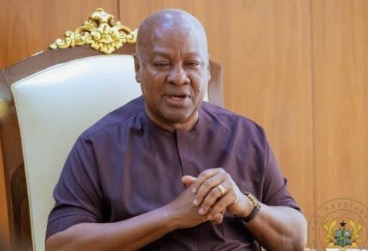
President John Dramani Mahama has announced that government plans to commit US$2 billion a year for four years to accelerate Ghana’s industrialisation, as he cut the sod for construction of the 1,238-acre Afienya Industrial Park on Thursday, October 15, 2026.
The funding will come from the government’s proposed US$10 billion New Economy Programme, which is expected to start in 2027. Half of the money is earmarked for agriculture and agro-processing, with the rest going to industry and infrastructure that links producers to markets.
The new park is expected to host more than 120 enterprises. Government says it is a response to growing investor interest and to the lack of space at the Tema Export Processing Zone, which is now at full occupancy.
According to reports, the full framework of the New Economy Programme will be presented to Parliament in the 2027 Budget.
Mahama’s US$2bn annual industrialisation plan explained
The President said the investment is intended to expand domestic production, create jobs and position Ghana as a manufacturing and logistics hub for West Africa.
He described the Afienya project as “a strategic response to growing investor interest in Ghana” and said government was “intentional about unlocking opportunities for growth.”
The plan follows a string of industrial announcements in recent weeks, including the commissioning of a new production line at Tema, covered in our report on Nestlé Ghana raising its Tema evaporated milk capacity to 30,000 tonnes.
New Economy Programme funding at a glance
- Total programme size: US$10 billion
- Annual commitment: US$2 billion
- Duration: four years
- Share for agriculture and agro-processing: 50%
- Remaining share: industry and market-linking infrastructure
- Expected start: 2027, with details due in the 2027 Budget
Afienya Industrial Park: size, location and facilities
The 1,238-acre enclave sits along the Eastern Corridor Road, close to the Port of Tema and the Tema–Mpakadan standard-gauge railway line.
It will provide serviced plots and ready-to-use factory shells, backed by electricity, water, roads, drainage, waste treatment and security. The Ghana Free Zones Authority (GFZA) will provide the facilities.
Fourteen companies have already been allocated land at the park, according to GFZA Chief Executive Dr Mary Awusi.
Priority sectors for the Afienya park
Government is targeting investment in:
- Cocoa, cashew and oil palm processing
- Textiles and garments
- Pharmaceuticals and medical consumables
- Automotive components and assembly
- Light engineering
- Logistics, data services, business process outsourcing, renewable energy and green manufacturing
Free zones exports reach US$2.34bn by mid-2026
Dr Awusi said free zone enterprises had exported about US$2.34 billion by the second quarter of 2026, compared with US$3.1 billion for the whole of 2025.
Capital investment stood at US$161 million by Q2 2026, against US$279 million for full-year 2025. There were 334 licensed enterprises as of Q2 2026, employing 78,155 people directly and more than 84,000 indirectly.
She noted that the Authority’s own funds would not cover the full cost of developing the park and called for more public and private support.
Litigation-free land assured for investors
Land disputes have long been a hurdle for industrial projects in Ghana. The President assured investors that “the land is litigation-free, the services will be available,” urging them to “establish your businesses here, develop your products here.”
Trade, Agribusiness and Industry Minister Elizabeth Ofosu-Adjare, who chairs the GFZA Board, said “access to undisputed land was critical” and thanked traditional authorities and host communities for releasing the land.
What the Afienya Industrial Park means for workers and local businesses
For residents of Afienya and surrounding communities, the park could bring new factory jobs. The President called for training programmes so local people can access those jobs.
He also urged that local farmers, transport operators, suppliers and small businesses be integrated into the supply chains of companies that set up in the enclave.
For farmers, the decision to direct half of the New Economy Programme to agriculture and agro-processing signals more support for crops such as cocoa, cashew and oil palm.
What happens next
Construction of infrastructure at the park is expected to proceed, with funding support from the New Economy Programme once it begins in 2027.
The programme’s full framework is due before Parliament in the 2027 Budget. More details on the official free zones regime are available from the Ghana Free Zones Authority.
Key details at a glance
- Sod cut for Afienya Industrial Park on Thursday, October 15, 2026
- Park size: 1,238 acres, for more than 120 enterprises
- Government to commit US$2bn a year for four years under the US$10bn New Economy Programme
- 50% of the programme earmarked for agriculture and agro-processing
- 14 companies already allocated land at the park
- Free zone exports hit about US$2.34bn by Q2 2026
- Programme framework to be presented in the 2027 Budget
FAQs
Where is the Afienya Industrial Park located?
It is along the Eastern Corridor Road near the Port of Tema and the Tema–Mpakadan railway line. It covers 1,238 acres.
What is Mahama’s New Economy Programme?
It is a proposed US$10 billion programme that will invest US$2 billion a year over four years in industry, agriculture and infrastructure, starting in 2027.
How many companies will the Afienya Industrial Park host?
The park is designed for more than 120 enterprises, and 14 companies have already been allocated land.
The Afienya Industrial Park and the US$2 billion-a-year pledge mark government’s biggest push yet to ease pressure on the full Tema Export Processing Zone and grow Ghana’s manufacturing base. Much now depends on the 2027 Budget, where the New Economy Programme’s details are expected to be laid out.