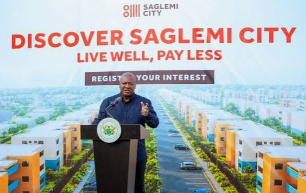
President John Dramani Mahama has directed the Minister of Finance to allocate GH¢1 billion in the 2027 Budget as government’s contribution to a GH¢3 billion National Housing Fund (NHF), a revolving fund meant to expand access to affordable homes and rental support in Ghana.
The President made the announcement on Wednesday, October 7, 2026, at the maiden National Conference on Housing Finance in Accra.
“I have directed the Minister of Finance to allocate one billion Ghana cedis in next year’s budget as government’s contribution to the three billion revolving fund,” he said.
The directive comes as Ghana grapples with a housing deficit of about 1.8 million units, and as tenants continue to struggle with high rent advance demands, particularly in Accra.
GH¢1 billion for the GH¢3 billion National Housing Fund
The GH¢1 billion will form government’s share of the GH¢3 billion National Housing Fund. The fund is structured as a revolving mechanism, meaning money recovered from beneficiaries is recycled to finance more housing projects and households.
According to the President, more than 1,000 people have already been supported to own homes through the Fund and its partner financial institutions.
Housing Fund figures at a glance
- Government contribution in 2027 Budget: GH¢1 billion
- Total size of the National Housing Fund: GH¢3 billion
- Ghana’s housing deficit: about 1.8 million units
- Cedi mortgage rate under the scheme: 8.4% (down from 13.5%)
- Developer financing rate: 10.4%
- People supported to own homes so far: more than 1,000
- Share of existing housing described as inadequate: over 30% (2024 Ghana Housing Profile)
Mortgage rates fall from 13.5% to 8.4%
President Mahama said cedi-denominated mortgages under the arrangement now cost 8.4%, down from 13.5%. Financing for developers is being offered at 10.4%.
He stressed that Ghana’s housing problem is not only about the number of units available, but also about whether households can finance them.
He noted that self-employed workers are especially affected because many do not have the conventional banking records that lenders usually require.
‘Easy Rent’: new scheme to pay rent advances for workers
The President announced that government will introduce “Easy Rent,” a new National Housing Fund programme under which the Fund will pay rent advances on behalf of workers, who will then repay in monthly instalments.
Easy Rent will run alongside the existing National Rental Assistance Scheme, which also provides rent advances to qualifying tenants who repay monthly.
Details such as eligibility criteria and the launch date of Easy Rent were not announced at the conference.
Mahama recounts his own rent struggle
Speaking at the conference, President Mahama recalled how difficult it was for him and his wife, Lordina, to find accommodation as a young couple, before they eventually settled at Madina New Road.
“The miles we covered with estate agents roaming the sprawling city of Accra in search of something that was suitable and affordable was a very exhausting exercise,” he said.
He cited chalewote fees, several years of rent paid in advance and an extra month’s rent paid to agents, costs he said “almost ruined our finances even before we had started married life together.”
Rent pressures in the capital have been a recurring concern, as GhanaTrends reported earlier in Accra Rents Skyrocket: Nataki Kambon Highlights Housing Shortage Crisis.
What the Housing Fund means for tenants and home buyers
For tenants, the planned Easy Rent scheme could reduce the burden of paying one or more years of rent upfront, since repayments would be spread monthly.
For prospective home owners, the larger fund and lower 8.4% mortgage rate could make home ownership more reachable, especially for workers who have struggled to qualify for bank loans.
The President said rent advances often drain savings that young Ghanaians could otherwise use for education or to start small businesses.
What happens next
The GH¢1 billion allocation is expected to appear in the 2027 Budget Statement, which the Finance Minister will present to Parliament. Budget documents are published by the Ministry of Finance.
Government is also expected to roll out the Easy Rent programme under the National Housing Fund, with further details on how workers can apply yet to be announced.
Key details at a glance
- President Mahama directed the Finance Minister to allocate GH¢1 billion in the 2027 Budget for the National Housing Fund.
- The amount is government’s contribution to a GH¢3 billion revolving fund.
- The announcement was made on October 7, 2026, at the maiden National Conference on Housing Finance in Accra.
- Cedi mortgage rates under the scheme have dropped to 8.4% from 13.5%; developer financing is at 10.4%.
- More than 1,000 people have been supported to own homes through the Fund.
- A new “Easy Rent” programme will pay rent advances for workers who repay monthly.
- Ghana’s housing deficit stands at about 1.8 million units.
FAQs
How much is the National Housing Fund in Ghana?
The National Housing Fund is a GH¢3 billion revolving fund. President Mahama has directed that GH¢1 billion be allocated in the 2027 Budget as government’s contribution.
What is the Easy Rent scheme in Ghana?
Easy Rent is a new National Housing Fund programme announced by President Mahama, under which the Fund pays rent advances for workers, who then repay monthly. Eligibility details have not yet been announced.
What is the mortgage rate under Ghana’s National Housing Fund?
According to President Mahama, cedi-denominated mortgages now attract 8.4% interest, down from 13.5%, while developer financing is at 10.4%.
President Mahama’s GH¢1 billion directive for the 2027 Budget signals a bigger push to tackle Ghana’s 1.8 million-unit housing deficit through cheaper mortgages and the new Easy Rent scheme. Attention now turns to the 2027 Budget Statement and the rollout details for tenants and home buyers.