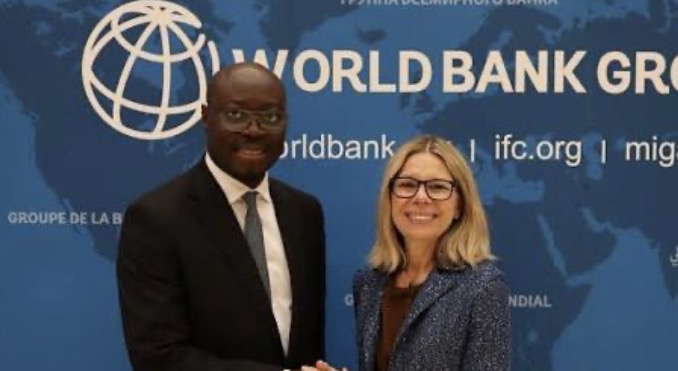
The World Bank has kept its forecast for Ghana’s economic growth in 2026 at 4.8%, and expects expansion to pick up to 4.9% in 2027 and 5.0% in 2028. The projections are contained in the Bank’s October 2026 Africa Economic Update, titled “Building AI-Readiness”, released on Wednesday, October 7, 2026.
The Bank said growth will be supported by the services sector, a recovery in oil and gas production, and ongoing structural and fiscal reforms.
The decision to hold the forecast comes even though growth slowed slightly in the second quarter of 2026. According to the report, the outlook rests on “resilient domestic economic activity, rapid disinflation and progress in the country’s debt restructuring programme.”
The 4.8% figure for 2026 would be lower than the 6.0% growth recorded in 2025 and the 5.8% recorded in 2024.
World Bank Ghana growth forecast: 4.8% in 2026, 4.9% in 2027
The World Bank’s projections show a gradual pick-up in growth over the next three years after a slower 2026.
- 2024 growth: 5.8%
- 2025 growth: 6.0%
- 2026 forecast: 4.8% (unchanged)
- 2027 forecast: 4.9%
- 2028 forecast: 5.0%
Ghana Q2 2026 GDP growth slowed to 6.0%
The report notes that real GDP grew by 6.0% year-on-year in the second quarter of 2026, down from 6.6% in the same period of 2025. The Bank said “economic activity remained robust in the second quarter of 2026, although growth moderated slightly.”
Growth was driven by strong domestic demand. Investment rose by 53.0%, while overall domestic demand increased by 11.2%. GhanaTrends earlier reported the Ghana Statistical Service’s Q2 2026 GDP figures showing 6% growth as ICT surged.
Services and ICT lead Ghana’s economic growth
The services sector expanded by 8.0% and contributed nearly 60% of total GDP growth. Information and communications technology (ICT) was among the strongest performers, growing by 30.9%.
Industry grew by 4.3%, up from 2.4% a year earlier, helped by higher oil and gas output.
Agriculture slowed to 3.9% from 7.1%, mainly because of a significant decline in fishing activity. The Bank said growth “remained concentrated in services, ICT, and hydrocarbons, while momentum weakened across parts of the non-oil economy.”
- Services: 8.0%
- ICT: 30.9%
- Industry: 4.3% (up from 2.4%)
- Agriculture: 3.9% (down from 7.1%)
Ghana inflation forecast to fall to 8% in 2026
The World Bank expects consumer price inflation to fall from 14.2% in 2025 to 8.0% in 2026 and remain around that level through 2028.
The Bank noted that the Bank of Ghana has kept its policy rate at 14%.
Ghana public debt and investor confidence improve
According to the report, Ghana’s public debt fell from 70.1% of GDP at the end of 2024 to 48.8% at the end of 2025. It is estimated to rise modestly to 52.6% of GDP in 2026.
The Bank said Ghana was reclassified to “moderate risk on both its external and overall debt” during its Article IV consultation, making it “the first country since the 2022 debt distress wave to exit the high-risk category altogether.”
Investor sentiment has also improved. Ghana’s sovereign spreads narrowed from about 2,828 basis points in 2023 to around 239 basis points by August 2026, following the completion of a debt exchange in July 2026.
How Ghana compares with West and Central Africa
The World Bank projects growth of 4.5% for West and Central Africa in 2026, rising to an average of 4.7% in 2027–28. For Sub-Saharan Africa as a whole, it projects growth of 4.3% in 2026.
That places Ghana’s 4.8% forecast slightly above both regional averages.
What the World Bank forecast means for Ghanaians
A stable growth outlook and lower inflation point to some relief on prices for households, especially if the 8% inflation projection holds.
However, slower growth in agriculture and weaker activity in parts of the non-oil economy mean the gains may not be felt evenly. Fishing communities, in particular, are linked to the sharp drop in fishing activity flagged in the report.
For businesses, the narrowing of sovereign spreads and Ghana’s improved debt rating suggest better access to financing conditions over time.
What happens next for Ghana’s economy
The World Bank flagged downside risks, including disruptions to agriculture and volatility in global energy markets linked to conflict in the Middle East.
Attention will now turn to the government’s 2027 budget and further GDP and inflation data from the Ghana Statistical Service. Full details are available on the World Bank’s Ghana country page.
Key details at a glance
- Report: World Bank October 2026 Africa Economic Update, “Building AI-Readiness”
- Ghana 2026 growth forecast: 4.8% (unchanged)
- 2027 and 2028 forecasts: 4.9% and 5.0%
- Q2 2026 real GDP growth: 6.0%, down from 6.6%
- Inflation forecast: 8.0% in 2026, from 14.2% in 2025
- Public debt: 48.8% of GDP at end-2025, estimated 52.6% in 2026
- Sovereign spreads: about 239 basis points by August 2026
FAQs
What is Ghana’s GDP growth forecast for 2026?
The World Bank projects Ghana’s economy will grow by 4.8% in 2026, unchanged from its earlier forecast. It expects growth of 4.9% in 2027 and 5.0% in 2028.
What will Ghana’s inflation be in 2026?
The World Bank expects Ghana’s consumer price inflation to fall to 8.0% in 2026, down from 14.2% in 2025.
Is Ghana still in debt distress?
According to the World Bank, Ghana has been reclassified to moderate risk of debt distress on both external and overall debt. Public debt fell to 48.8% of GDP at the end of 2025.
The World Bank’s latest outlook keeps Ghana on a steady path, with 4.8% growth expected in 2026, falling inflation and improving debt indicators, though weaker agriculture and global energy risks could weigh on the recovery.