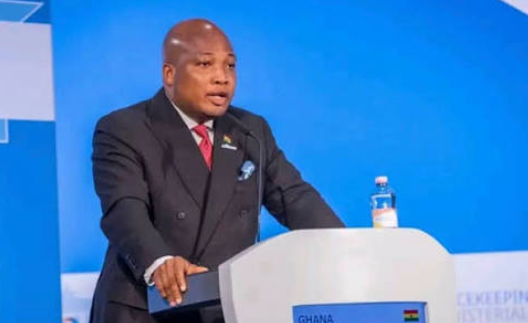
Foreign Affairs Minister Samuel Okudzeto Ablakwa says Ghana’s foreign policy “will not be dictated by other countries,” as the government pushes ahead with its bid for BRICS partner-country status. He made the remarks on JoyNews’ Newsfile on Saturday, October 17, 2026.
The minister restated that the Mahama administration is seeking partner status with the bloc, not full membership. He tied the move to Ghana’s tradition of non-alignment, which dates back to Dr Kwame Nkrumah.
His comments come amid growing debate over the BRICS bid. Damongo MP and Ranking Member on Parliament’s Foreign Affairs Committee, Samuel Abu Jinapor, said on the same programme that the government’s expected economic benefits were unrealistic. APC leader Hassan Ayariga has also asked Parliament to scrutinise the move.
Ablakwa first announced on Tuesday, October 6, that Cabinet had approved a formal application to join BRICS, according to the Ghana News Agency.
Ablakwa: Ghana’s foreign policy guided by national interest
Speaking on Newsfile, Ablakwa said the government must keep its freedom to pursue partnerships that serve Ghana’s interests.
“With all due respect, the foreign policy of Ghana will not be dictated by other countries, with all due respect,” he said.
He added: “We cherish the cordial relationship with the United States of America, but Article 40 of our constitution is very clear that our foreign policy consideration must be guided by our national interest.”
Ghana’s BRICS bid rooted in Non-Aligned Movement history
Ablakwa linked the BRICS partnership to Ghana’s role in the Non-Aligned Movement. “Ghana is a founding member of the Non-Aligned Movement, which was established in 1961,” he said.
He noted that Nkrumah rallied leaders including Yugoslavia’s Josip Broz Tito, Egypt’s Gamal Abdel Nasser and the prime ministers of India and Indonesia to form the movement.
Ablakwa was on the same programme where he defended the government’s GH¢49.72 million evacuation of Ghanaians from South Africa. GhanaTrends earlier reported that children received the same GH¢5,500 as adults in the evacuation.
BRICS partner status vs full membership: what Ghana is seeking
When Ablakwa first announced the plan on October 6, he said Cabinet had decided that Ghana should apply to join BRICS. He later clarified that Ghana would apply as a partner country rather than a full member.
Partner status gives a country a formal channel to engage BRICS members without full membership. Nigeria and Uganda are among the African countries that already hold this status.
- BRICS full members (11): Brazil, China, Egypt, Ethiopia, India, Indonesia, Iran, Russia, Saudi Arabia, South Africa and the UAE
- Partner countries admitted in 2025 (10): Belarus, Bolivia, Kazakhstan, Cuba, Malaysia, Nigeria, Thailand, Uganda, Uzbekistan and Vietnam
- Ghana’s request: partner-country status, not full membership
- Cabinet decision announced: October 6, 2026
Ablakwa has said the move will complement, not replace, Ghana’s relationships with traditional partners such as the IMF and World Bank. “We are not going to walk away from our traditional partners who value that relationship, but we must have new friends,” he said at the October 6 announcement.
Jinapor questions BRICS economic benefits
Samuel Abu Jinapor welcomed the decision to pursue partnership rather than full membership, calling it reassuring. He also noted that early BRICS engagement began under former President Nana Addo Dankwa Akufo-Addo.
However, he argued Ghana would still need IMF clearance to access certain financial assistance. He said the claim that the partnership would help Ghana move away from the dollar and stabilise the cedi “is a bit simplistic because you need IMF approval.”
Earlier in October, Jinapor warned on Joy FM that “there’s absolutely no free lunch” and urged Ghana to study the experiences of existing members such as Ethiopia.
Ayariga, Minority demand parliamentary scrutiny of BRICS move
In a statement on October 17, Hassan Ayariga urged the Speaker and MPs to demand a full briefing from the Foreign Affairs Minister on the bid’s economic justification, risks, financial implications and legal obligations.
He said any arrangement that qualifies as a treaty, agreement or convention under Article 75 of the 1992 Constitution must follow ratification procedures. “Ghana belongs to Ghanaians,” he said.
The Minority in Parliament has also called for an urgent briefing on the proposal.
What the BRICS partnership means for Ghanaians

The government says the bid is meant to diversify Ghana’s partnerships and widen options for trade, investment and development financing.
Critics say the benefits must be clearly spelt out, including how the partnership would affect Ghana’s relations with the United States and its ongoing work with the IMF.
For now, no costs, timelines or specific economic targets for the partnership have been made public.
What happens next for Ghana’s BRICS application
Admission as a partner country requires the agreement of existing BRICS members. India’s External Affairs Minister, Dr Subrahmanyam Jaishankar, said during an October visit to Accra that India supports Ghana’s aspirations but that it is “an issue of collective consideration.”
Pressure is also building for Ablakwa to brief Parliament formally on the bid.
Key details at a glance
- Ablakwa says Ghana’s foreign policy “will not be dictated by other countries.”
- He spoke on JoyNews’ Newsfile on Saturday, October 17, 2026.
- Ghana is seeking BRICS partner-country status, not full membership.
- Cabinet’s decision to apply was announced on October 6, 2026.
- Ablakwa cited Article 40 of the 1992 Constitution and Ghana’s role in founding the Non-Aligned Movement in 1961.
- Samuel Abu Jinapor says Ghana would still need IMF approval for some financial support.
- Hassan Ayariga and the Minority want Parliament fully briefed on the bid.
FAQs
Is Ghana joining BRICS as a full member?
No. Foreign Affairs Minister Samuel Okudzeto Ablakwa says Ghana is applying for BRICS partner-country status, not full membership.
What did Ablakwa say about Ghana’s BRICS bid and the US?
Ablakwa said Ghana cherishes its relationship with the United States but its foreign policy “will not be dictated by other countries” and must be guided by national interest under Article 40 of the Constitution.
Which African countries are BRICS partners?
Nigeria and Uganda became BRICS partner countries in 2025, while Egypt, Ethiopia and South Africa are full members.
Ghana’s BRICS partner bid has moved from a Cabinet decision to a full-blown national debate. Ablakwa insists the move is rooted in non-alignment and national interest, while the Minority and other political voices want Parliament involved and the benefits clearly explained before Ghana goes further.